
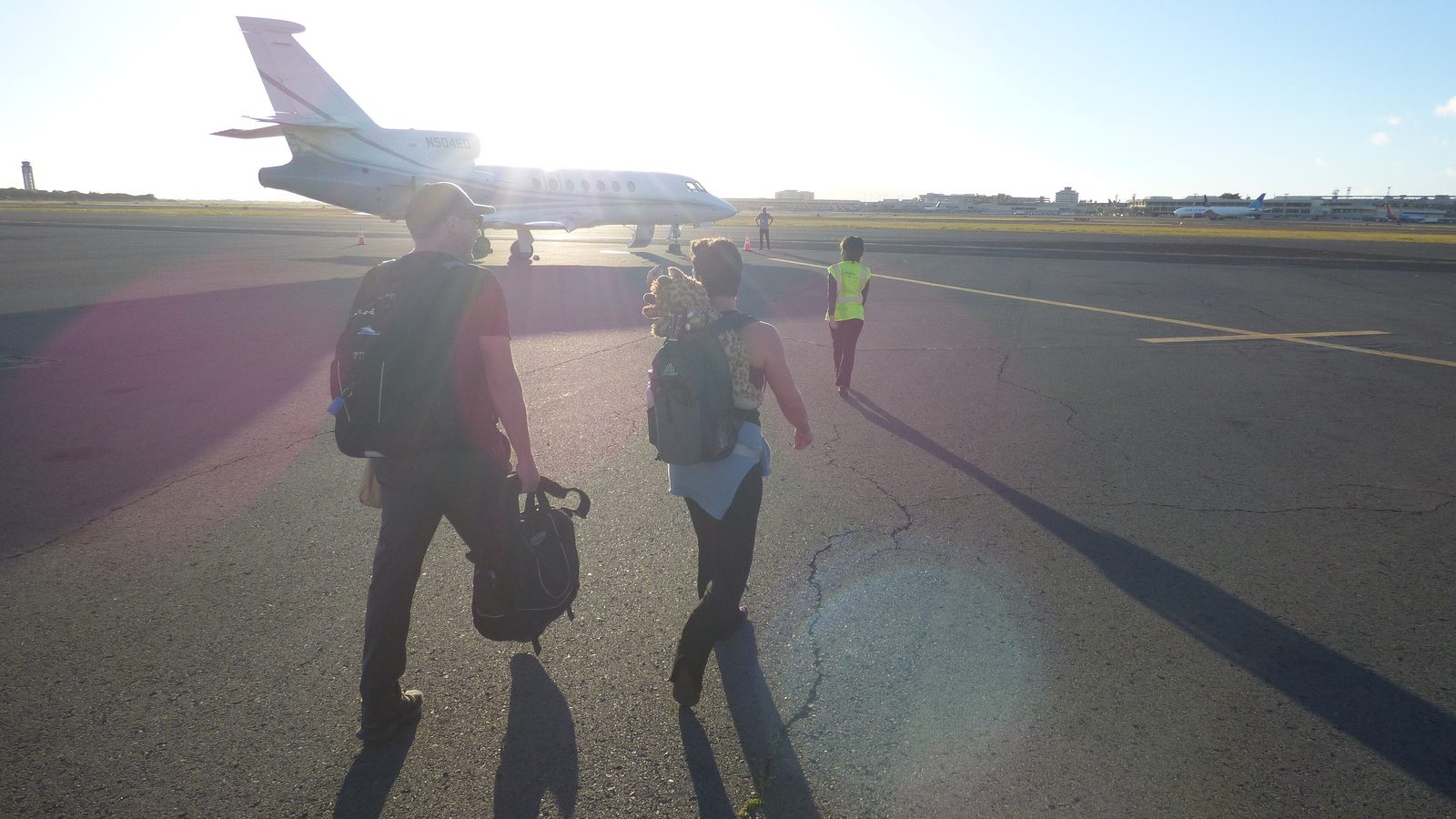
Two trends are reshaping how passengers reach the aircraft. Fractional operators and FBOs are building private terminals around a seamless "curb-to-cabin" experience. Meanwhile, robotaxis have started serving airport curbs. Both are aimed at the same traveler: younger, wealthier, and app-driven, someone who wants to be known and not processed. Both also lead to the same question for airport sponsors, especially at smaller airports: if fewer people park or rent a car, what pays the bills? To be clear up front: the forecasts below are a3i's analysis, not established fact.
1. The new luxury: terminals built for the passenger
Aviation Week's BCA reports that NetJets, Flexjet and Magellan Jets are making "multimillion-dollar investments" in branded private terminals, and that FBOs are adding hotel-style lounges, crew rest areas and concierge services (BCA). Some numbers from that report:
- NetJets runs more than 10 exclusive-use U.S. terminals. It is building in Augusta and Austin and reworking its Teterboro terminal.
- Flexjet has six branded U.S. terminals and five more sites planned, including a $36 million Scottsdale terminal with private underground parking.
- FBO chains are upgrading too. Atlantic Aviation is spending $40 million on a four-story renovation at Boca Raton, and Jet Aviation opened its 12th U.S. FBO at Opa-locka in July.
BCA ties the shift to demographics. Clients are getting younger, driven partly by generational wealth transfer and by wealth created in AI and tech, and they "expect seamless technology integration." Private terminals, BCA notes, "focus exclusively on client experience rather than fuel sales." BCA's editor puts it bluntly: FBOs "that feel more like car rental experiences" need to step up their game (BCA editorial).
That matches the argument in my paper The Evolution of the NPIAS: Adapting to Generational Shifts and the AI Revolution. The national airport system was designed around the hub-and-spoke priorities of the Silent and Boomer generations. Gen Z and Gen Alpha expect app-driven, on-demand journeys that blend autonomous vehicles with eVTOL aircraft.
2. The ground side: from rental counter to robotaxi
Parking and rental cars carry airport finances. In FAA CATS data for FY2023, U.S. airports earned $13.2 billion in non-aeronautical revenue. Parking and ground transportation made up $6.0 billion of that (46%) and rental cars $2.4 billion (18%) (ACI-NA presentation, citing FAA CATS Report 127). Smaller airports are more exposed to rental cars. An ACRP guide using CATS data puts rental car revenue at $6.05 per enplanement at non-hubs versus $2.23 at large hubs, and at 17% to 26% of non-aeronautical revenue depending on hub size (ACRP, via National Academies).
Two smaller airports show what that looks like on the books: - Syracuse (SYR): in the fiscal year that ended June 30, 2025, parking brought in $23,360,141 of $55,525,694 in total operating revenue, or 42.1% (audited financial statements). - Dayton (DAY): in 2025, parking brought in $9,318,963 and the rental car concession $4,262,971. Against the aviation department's roughly $31.57 million in revenue, that is about 29.5% and 13.5%. Ground leases rose 6.0%, "due to newer airport tenants such as Joby and Sierra Nevada Corporation" (City of Dayton briefing, Feb 4, 2026).
Autonomous rides have reached the curb. - Waymo picks up and drops off at Phoenix Sky Harbor's Terminals 3 and 4 and at Sky Train stations (Waymo). It began serving San José in November 2025 (Waymo). SFO approved Waymo passenger service on Jan 29, 2026 (SFO). Pickups are at the Rental Car Center and the Grand Hyatt at SFO, not the terminal curb (Waymo). - Tesla began giving Robotaxi rides in its purpose-built, steering-wheel-free Cybercab in Austin on Sept 3 (Tesla Q3 2026 update). On its Oct 21 earnings call, Tesla said it will start selling Cybercabs to customers by year-end. NHTSA is investigating whether the vehicle meets federal safety standards (TechCrunch). In September, Tesla posted an interest form for businesses that want to buy Cybercab fleets or provide "mobility hubs and infrastructure" (TechCrunch).
Musk also said Cybercab is "primarily going to be something that is offered as like transport as a service," and that "the vast majority" will be Tesla-owned (TechCrunch). That is Transportation-as-a-Service in plain words: the vehicle comes to you, and it doesn't sit in an airport garage.
Update (Nov 2, 2026): Since this article was drafted, Waymo's airport page has added Harry Reid (LAS), Nashville (BNA) and San Antonio (SAT) (Waymo). Tesla opened Robotaxi service in Fort Worth today (Tesla Robotaxi), and said on its Q3 call that Cybercab rides come to Dallas this month (EVwire).
In The Disruptive Potential of Autonomous Vehicles on Short-Haul Domestic Flights, I used Rochester (ROC) as a case study. I argued that robotaxis could pull trips under 250 miles off regional flights, and the paper's revenue table rates the impact on parking a "High decline, as robotaxis enable drop-offs without on-site storage" and on rental cars and taxis a "Sharp drop, as robotaxis replace traditional ground transport."
3. Why the initial impact is low
a3i's analysis: near-term revenue exposure is modest. - Availability: Fully driverless service exists in a limited set of metros. At SFO, robotaxis still don't reach the terminal curb. Most small and non-hub airports have no AV service at all. - Ride-hailing precedent: Airports have absorbed a ground-transport shock before. ACRP-funded research found that ride-hailing fees "typically offset the losses from other modes" (TRB webinar). An earlier ACRP synthesis, however, found that ride-hailing fees fell short of lost parking revenue at most airports (ACRP problem statement). How airports set their AV access fees will matter. - Energy: My NASA Contractor Report, Electrification of Aviation's Impact on the Airport and Airway Trust Fund, found that the fuel categories most exposed to electrification (avgas, non-commercial jet fuel and fractional-flight fuel) contributed "approximately $277 million of the $11,402 million total tax revenues, representing approximately 2.43%" of Trust Fund revenue in FY2022. The near-term national hit is small. Locally it isn't: electrified aviation "represents a loss of approximately 64%" of avgas-equivalent gallons, fuel sales and excise tax in both the LOW and BASE forecasts. The report also warns that "the transition period may see a temporary decrease in revenue as fuel sales decline before electric charging can fully compensate." Its remedy includes charging and electricity flowage fees, plus "increased revenue from restaurants, shops, and parking near charging stations."
A note on my earlier position. In my AV paper I framed parking and rental car losses as a "High decline" and a "Sharp drop." In light of new information in a continually changing environment, including the ride-hailing revenue research above and how slowly driverless service is reaching airport curbs, I now see the near-term impact as low and the decline as gradual. The direction hasn't changed. The timing has.
4. Why the long-term trend matters
a3i's analysis: Over a decade, the direction is clear even if the pace isn't. Ground access shifts from owning cars, parking them and renting them toward autonomous vehicles and TaaS. Parking garages and rental car centers become curbs, staging lots and charging depots. Airports that price access early, by setting AV trip fees, staging-lot leases and charging concessions, will keep more of the revenue base than airports that wait.
5. From private lounge to vertiport lounge
This is the forward-looking part, so read it as a3i's analysis. A curb-to-cabin terminal means a quiet lounge, direct car-to-aircraft access and few touchpoints. A good vertiport needs the same things. FBOs are already linking the two: - The Signature–UrbanV alliance, launched Oct 21, will build advanced air mobility (AAM) service starting from existing Signature terminals, integrating electric aircraft "into existing aviation facilities, including charging, aircraft handling and guest services," before moving to dedicated vertiports (Signature). - Atlantic's VertiPorts by Atlantic plans vertiport networks that draw on its FBO sites (VertiPorts by Atlantic). Atlantic is also preparing eVTOL chargers at New York's East 34th Street Heliport (Atlantic). - Million Air brought BETA chargers online at Tallahassee (Million Air). - On the operator side, Joby (through Blade) "currently operates nine passenger lounges in the New York area and across the South of France" (Joby).
Florida shows what a state playbook looks like. FDOT's Advanced Air Mobility Business Plan: Florida's Aerial Highway Network (November 2025) says "Early stages of AAM will rely heavily on existing airport infrastructure," and lists new needs including "charging stations for electric aircraft." It advises that "At least 1 megawatt power supply (and potentially higher) should be planned for vertiports." It also describes vertiports as places that "often connect to different modes of travel," providing "links between ports, airports, rail, and intracity transit." Among revenue sources it lists infrastructure income from "Vertiport (landing) fees, power, leasing." Its list of airports with publicly expressed AAM plans includes Boca Raton and Miami-Opa Locka Executive, the same fields where BCA reports Atlantic's and Jet Aviation's new investments. a3i's analysis: that is the FBO business model with electrons instead of Jet A.
Two regulatory guardrails for sponsors of federally obligated airports: - No exclusive deals. Grant Assurance 22 requires the airport to be available "on reasonable terms and without unjust discrimination to all types, kinds, and classes of aeronautical activities," and Grant Assurance 23 says the sponsor "will permit no exclusive right for the use of the airport by any person providing, or intending to provide, aeronautical services to the public" (FAA Order 5190.6C, ch. 14). A branded FBO lounge is fine. A vertiport lounge or charger locked to one eVTOL maker is a likely compliance problem. - Updated rulebook. Minimum standards now fall under AC 150/5190-8, which replaced the cancelled -7. Compliance runs through Order 5190.6C. Airport revenue spent on ground-access projects is prorated to airport-passenger use (FAA CGL 2025-02). FAA's vertiport charging guidance (EB 105A) sets no fixed clearance distances and notes that "consensus has not been achieved" on charging standards (FAA EBs).
Picture a robotaxi pulling up to an FBO lounge and an eVTOL waiting on the ramp. Neither pays in parking, rental cars or fuel, so smaller airports should plan now for what will.
The bottom line
The luxury terminal is a preview, not a niche. It shows what the next generation of travelers expects from every airport. For sponsors of smaller airports, the job is to treat ground access and vertiport access as revenue lines to design now, before parking and rental car revenue erodes. Airports earn their money from what happens on the ground as well as from aircraft.
As a former NASA contractor, I wrote NASA Contractor Reports on aviation electrification and the Airport and Airway Trust Fund and on Regional Air Mobility. I began my career in NYSDOT's aviation office. At a3i global aeronautics advisors, we help airports, states and localities plan for these shifts. Let's talk: a3iglobal.com.
This article is general information, not financial or legal advice. AI tools assisted with research and drafting.