
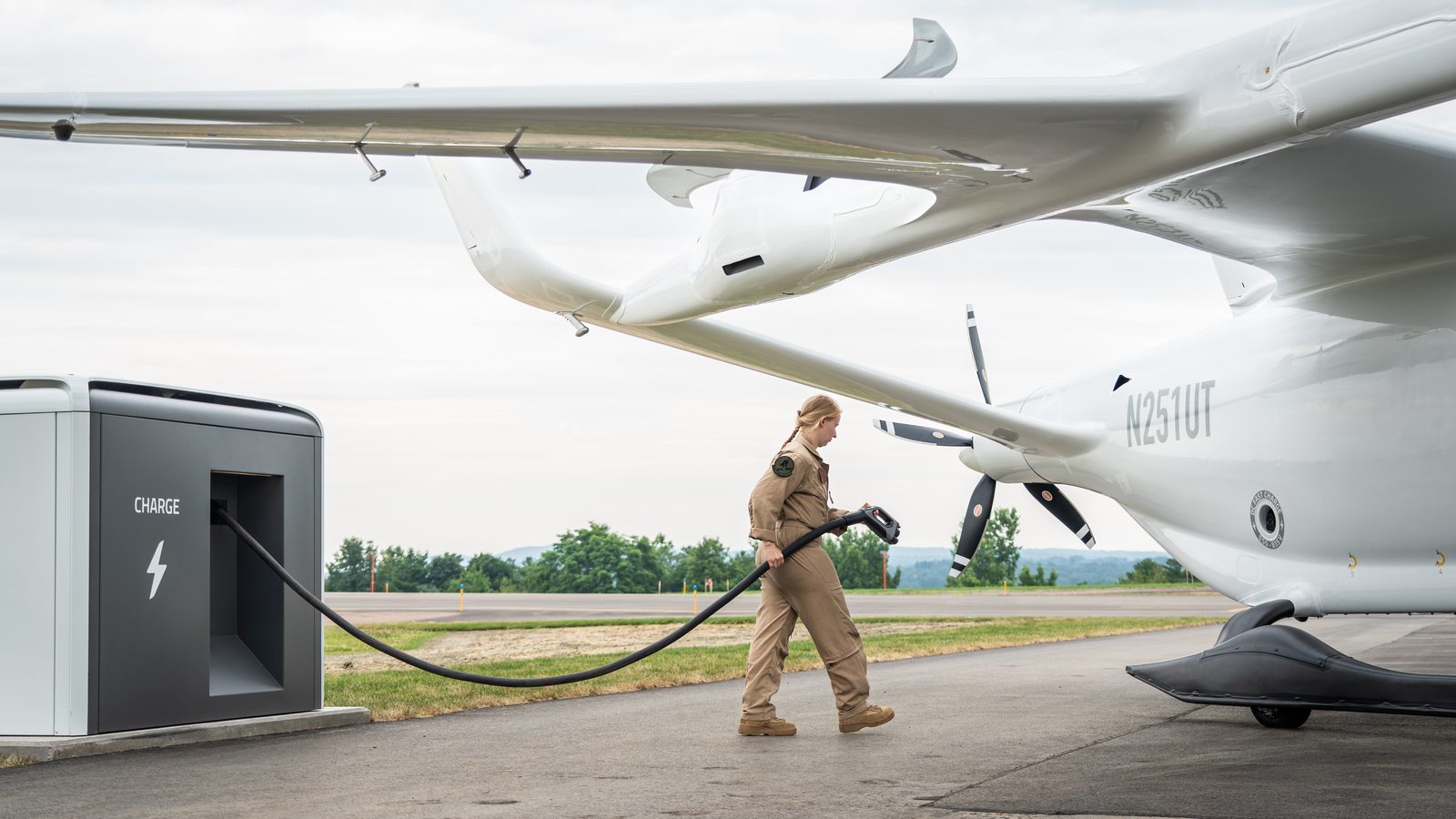
1. The opportunity: the power is going in first
BETA Technologies’ third-quarter 2026 results, released November 3, report that the company “Expanded Charging Network to 168 Sites” and increased its commercial aircraft backlog “to just over $4.0 billion,” representing 1,040 aircraft in firm and option orders.1 BETA’s charging page describes the 168 as sites built and in progress.2 These are company-reported figures, and BETA does not break them out by country or by public versus private site.
The sequence looks backward at first: chargers before certified aircraft. It follows from three facts.
- The utility takes longer than the paperwork. A DOE-supported white paper on EV charging says energizing a new high-powered site is “complex and time-consuming, often taking up to 2 years.”3 Cooperative utilities in the NRECA REWIRED study described service requests that “span 18–24 months,” and “up to 3-5 years if substation upgrades and line extensions are needed.”4 A sponsor that waits for a type certificate to call the utility adds a full interconnection cycle to its timeline.
- Aircraft are already flying. Test, demonstration and pilot-program flights need power on the routes they fly. In Florida, BETA says nine charging sites are “currently online” and that it signed an agreement with the Florida Department of Transportation “to supply 34 chargers and thermal management systems” (the 34-unit figure is BETA-reported; we did not find an FDOT counterpart).5 Joby says its own chargers are in use at its Marina, California, flight-test center and at Edwards Air Force Base.6
- The same charger can serve the ground. BETA’s Charge Cube uses the Combined Charging System (CCS) found on electric cars, and BETA says ground EVs can use the same interface.2 The ACES consortium says its chargers will also be available to airport ground-support vehicles.7 A sponsor or FBO can justify part of the electrical upgrade on ground use while it waits for aircraft.
2. The requirements: ownership, power and the lease
A charger is a small box. The decisions behind it are not. In a3i’s view, a sponsor needs to settle three things before it orders one.
Who owns the charger. The options are the sponsor, an FBO, an aircraft maker (OEM) or a charging network. FAA’s Advanced Air Mobility infrastructure FAQ draws the main line: “Sponsor-furnished charging stations should be available to all aeronautical users (non-exclusive),” while “Exclusive-use AAM leased property with proprietary charging stations are not considered an exclusive-right.”8 Ownership decides who can use the charger, how it is priced and which grants, if any, can pay for it (Section 6).
Where the power comes from. BETA’s Charge Cube needs 480-volt, three-phase service at 420 amps and delivers up to 320 kilowatts.9 That fits many fields with existing three-phase service. A multi-pad site is a different project. An FAA-sponsored study found that eVTOL makers “reported peak DC charging loads of 300 kW to 1 MW,” and NREL recommended that vertiports “plan for 1 MW (and potentially higher).”10 FAA told airport consultants in 2024 that “eVTOL charging is likely to increase site load demand 6 to 7 times,” while “Current feeders generally could accommodate a 2-3x increase.”11
What the lease says. If an OEM or FBO is leasing ramp for chargers ahead of certification, the lease has to say what happens if the aircraft are late. Section 6 explains why.
3. Where chargers are actually in the ground
Announcements outnumber installs. We sorted the U.S. sites in our research by what the primary source actually says. “Installed” means a sponsor, operator or agency release states that the charger is commissioned or in use.
Installed and in use
- Capital Region International (LAN), Lansing, Michigan. The airport authority announced on July 30, 2025 that it had “installed the first electric aircraft charger in the state of Michigan,” the first of four BETA Charge Cubes to be deployed across the state from Michigan’s AAM Activation Fund.12
- Raleigh Executive Jetport (TTA), Sanford, North Carolina. NCDOT reported the state’s first electric aircraft charger was “used to power an electric aircraft for the first time” in March 2025. NCDOT funded the apron expansion that made room for it.1314
- West Virginia International Yeager (CRW), Charleston. Marshall University and BETA held a ribbon cutting in October 2026 for the “activation of BETA’s newest 320 kW Charge Cube” at Marshall’s flight school, and list Martinsburg (MRB) and Lewisburg (LWB) as online.15
- Kissimmee Gateway (ISM), Florida. Signature Aviation and BETA commissioned a Charge Cube and Thermal Management System there and used it for high-cadence demonstration flights in May 2026.16 Signature’s release lists ISM with five other Florida fields where BETA charging is installed: Duke Field (EGI), Bob Sikes (CEW), Gainesville (GNV), Tallahassee (TLH) and Jacksonville Executive at Craig (CRG).16
Used for a campaign, permanent plant still ahead
- Downtown Skyport, Manhattan. During Joby’s April–May 2026 flight campaign, Skyports says the heliport was “the key location where Joby managed aircraft operations and charging in Manhattan,” charging “directly from our grid power.” Permanent rapid charging is “tracking to be fully functional in 2027.”1718
Contracted, awarded or under construction (not yet confirmed online)
- East 34th Street Heliport, Manhattan. NYCEDC’s 2024 concession renewal requires Atlantic Aviation to “retrofit the heliport with the supporting infrastructure and charger installation within a year following Federal Aviation Administration (FAA) certification for commercial operations” of an eVTOL. Atlantic plans both CCS and Joby’s GEACS chargers, and has completed a site assessment with Con Edison.1920 We found no source confirming the chargers are installed.
- Salt Lake City International (SLC). UDOT reported in October 2026 a BETA Charge Cube “under construction” at the airport.21
- Four North Texas airports. The NCTCOG Regional Transportation Council approved $477,500 in local funds in September 2026 “to help four North Texas airports install charging infrastructure”: Greenville ($200,000) and Denton, Fort Worth Meacham and Granbury ($92,500 each). These are awards; installation has not been reported.22
- Van Nuys (VNY). Los Angeles World Airports’ board awarded Joby a 10-year lease in September 2026. Joby is to invest about $2.5 million in improvements that include “aircraft charging infrastructure” and “battery energy storage systems,” subject to City Council approval.23
- Columbus Airport (CSG), Georgia. A June 2026 city presentation requested $2.2 million “to construct an airside electric charging station and a dedicated vertiport,” with the charger planned in coordination with BETA.24 Local press reports council approval; we have not seen the city record.
Announced or agreed, not built (do not count as installed)
- Joby’s agreements with Clay Lacy at John Wayne (SNA) and with Helo Holdings at Kearny Heliport, New Jersey, announced in 2023 and 2024. We found no 2026 source confirming either is operating.2526
- Signature and Archer’s June 2024 MOU, which names Newark (EWR) and Chicago O’Hare (ORD) as first opportunities.27
- The ACES consortium (Archer, BETA and Macquarie Capital), which aims “to electrify up to 250 air taxi sites” over the next decade and is working with TxDOT to identify sites in Texas.7
- The Signature UrbanV Alliance, launched October 21, 2026, which named no sites, dates or dollars.28
The NYCEDC contract is the clearest example of this edition’s theme. The city did not wait for a certificate to set terms. It wrote the certificate into the lease as the trigger.
4. Applying the idea across the NPIAS
The funding path depends on the airport’s category, so a3i suggests the starting point scale the same way. Airport categories below are from the FAA NPIAS 2025–2029 data.29
| Airport type | Example in this edition | Starting move (a3i proposal) | Likely funding path |
|---|---|---|---|
| Large and medium hubs | SLC (large hub, under construction); EWR and ORD (MOU only) | Utility load study and ALP reservation for a multi-pad, 1 MW-class site; FBO or network-owned chargers | Private and FBO capital; AIG with a revenue case; AIP funds revenue-producing aeronautical facilities only at nonprimary and Military Airport Program airports |
| Small hubs and nonhubs | LAN and CRW (nonhubs, installed) | One 320 kW-class unit on existing three-phase service, open to all users | State programs and private partners; AIG with a revenue case |
| Relievers and other nonprimary | TTA (reliever, installed) | Charger plus a §47140 energy assessment, sized for growth | Nonprimary entitlements under the fuel-farm rules; AIG; state and regional grants |
| Heliports and unclassified | East 34th Street and Downtown Skyport (city-owned) | Concession terms that tie installation to certification; early utility request | Concessionaire capital under city contract |
Two state notes matter. North Carolina and Michigan are State Block Grant states, so NCDOT and MDOT select AIP projects at their nonprimary airports. And state money is moving faster than federal money: Michigan’s grant to BETA for four Charge Cubes was $2.6 million, according to the airport and trade press.30
5. Standalone vertiports and heliports: outside the fence
This is regulatory analysis, not legal advice.
Charging off-airport follows a different track. A new pad and charger at a site that is not under a federal grant agreement does not go through an Airport Layout Plan. Instead, 14 CFR Part 157 defines “airport” to include “any airport, heliport, helistop, vertiport,” and requires notice on FAA Form 7480-1 “90 days in advance.”31 FAA’s AAM FAQ adds that converting a heliport to a vertiport requires a new 7480-1.8 FAA’s Part 157 determinations “are only advisory” and “will not consider environmental or land use compatibility impacts,”31 so those questions fall to the city and the state.
Both Manhattan heliports in Section 3 show how that works. In practice, the terms that matter are in the city’s concession contracts, not in an AIP grant. For a city planning several sites, the NYCEDC clause is a template: set the electrification duty and its trigger in the contract.
6. Regulatory hurdles, and how to clear them
This is regulatory analysis, not legal advice.
“Actual need.” The AIP Handbook requires “an Actual Need… within the next five years.” Its own example of a project that fails is a runway extension “to attract a new class of aircraft”: “the need is speculative and not based on documented future need.”32 That is the main risk for an AIP-funded charger before certification. Solution: document demand that does not depend on certification timing, such as a signed operator agreement, an FAA-approved forecast and a revenue case.
Revenue rules. AIP has no charger entry. The closest model is the fuel farm, which must be “owned by the sponsor,” must be at a nonprimary airport using “only nonprimary entitlements,” and must be “not exclusive use.”33 Treating a charger as a fuel farm is analysis by analogy, not FAA text. The Airport Infrastructure Grant (AIG) program is broader. FAA’s FAQ says “charging stations are considered fuel tanks,” and “Sponsors must provide justification demonstrating how these types of charging stations will increase revenue similar to that of traditional fuel.”34 AIG revenue facilities may be funded “at any airport, regardless of size,” and the AIP airside-needs test does not apply.35 Solution: choose the source on purpose. The fiscal 2023 AIG tranche is available until September 30, 2027.36
The §745 pilot. The 2024 FAA Reauthorization Act created an Electric Aircraft Infrastructure Pilot for up to 10 airports. It covers charging equipment and “on airport utility upgrades,” and it reaches operators “planning to operate at such airport with an associated agreement in place.” It has no type-certification requirement, and it ends October 1, 2028.37 FAA’s guidance says “Additional information on this pilot program is forthcoming.”38 We found no solicitation and no selections. Solution: sign the operator agreement now and put the project in the Airport Capital Improvement Plan, as FAA’s guidance advises.
Exclusive rights and land banking. Self-service is protected. FAA’s compliance manual lets an operator “refuel (including AVGAS, Jet-A, electric charging, and other fueling sources)” its own aircraft.39 The risk is the opposite. The manual says an exclusive-rights violation can occur when all suitable land is leased to one provider “who cannot put it into productive use within a reasonable period of time.”39 With certification dates uncertain, an OEM that banks ramp for future chargers creates that exposure. Solution: write development deadlines or a reversion clause into the lease.
Plug lock-in. Minimum standards adopted “for the purpose of protecting an exclusive right” can be a violation, for example “a standard that only one particular operator can reasonably or practically meet.”39 Solution: do not make one maker’s connector a minimum standard. Section 8 explains the split.
Approvals. FAA’s AAM FAQ says obligated airports “must update their ALP to include AAM infrastructure such as charging stations,” and that charging stations be identified in FAA’s OE/AAA airspace system.8 Part 77 notice is due “at least 45 days before the start date” of construction.40 FAA’s NEPA order, 1050.1G, has no categorical exclusion that names aircraft chargers or battery storage. The general one for “minor development items” (B-2.4(f)) may fit a single unit, and every exclusion still requires a review of extraordinary circumstances, including hazardous materials.41 Solution: ask the Airports District Office early for a documented CATEX determination, and plan for more review if the project adds a substation or large battery.
Selling electricity. In my 2025 NASA Contractor Report on aviation electrification, I noted that “Some states may have regulations limiting the resale of electricity, requiring airports to work closely with utility providers and regulators” (Section 12).42 Solution: confirm with the state utility regulator how the airport or its FBO may bill for charging before setting rates.
7. Partners
The utility comes first. FAA’s AAM considerations page advises “submitting interconnection requests as soon as possible” and pursuing utility agreements “in parallel with other permitting processes.”43 FBOs are already the main builders: Signature, Million Air and Avflight host many of the installed sites in Section 3.1630 OEMs and networks supply the hardware and, through ACES and Macquarie Capital, the capital.7 State aviation agencies fund aprons and grants, as NCDOT and Michigan did. Regional planning bodies, such as NCTCOG in Texas and OKI in southwest Ohio, are paying for chargers and for electrical plans.2244 Local fire officials and building departments enforce the codes. The Airports District Office decides eligibility, the ALP and the CATEX.
8. Infrastructure
The plug. The industry is split. BETA, Archer and ACES build on CCS, which ACES calls “the open charging standard endorsed by [GAMA].”7 Joby uses its own Global Electric Aviation Charging System (GEACS), whose specification it made “freely available to our industry” in 2023.6 FAA’s draft AC 150/5390-4, posted October 22, 2026, does not pick one. It lists CCS and the megawatt-class work still “under development,” and says “consensus has not been achieved.”45 Final design standards are expected in summer 2027.46 East 34th Street plans both, which is the safe answer for a site that wants every operator.
The wires. NREL’s FAA study notes that utility upgrades “can take up to 4 years,” and that transformer lead times rose “from weeks to more than 2 years.”10 Those are 2021–2022 data points, so treat them as a warning, not a forecast. Southwest Ohio’s airport electrical plans, prepared for OKI, plan one 300 kW eVTOL charger per field, with total costs from $2.36 million at Middletown to $9.57 million at Cincinnati Municipal. Several pair solar with a 500 kWh battery for peak shaving, and the Middletown plan allows 180 to 360 days for Duke Energy’s enabling work alone.44
The bill. Demand charges, billed on peak use, are an operating cost. We found no FAA grant source for them. A battery that shaves the peak may save more than it costs, but it also adds fire-code and environmental review.
The codes. FAA’s design documents point to NFPA 70 (the National Electrical Code) Article 625 for EV charging and Article 706 for energy storage, plus NFPA 855 and NFPA 418 for fire protection.45 The edition that applies is the one the state or local authority has adopted.
9. Public perception
Three concerns will come up. The first is battery fire. FAA’s vertiport engineering brief tells designers to “Consider fire fighting response to lithium battery incidents,” because of “the risk of thermal runaway propagation.”47 A sponsor can bring the fire department into the design and show where batteries sit relative to the safety areas. The second is cost to local ratepayers when a utility upgrades a feeder for an airport, and the answer is to publish who pays for what. The third is the empty charger, a public investment waiting on an aircraft that is late. Dual use with ground vehicles, and contracts like NYCEDC’s that tie installation to certification, answer that. These are a3i’s recommendations; we found no public-opinion survey on airport aircraft chargers.
10. Regulatory Corner: legacy rules versus what is needed
| Legacy rule | What is needed (a3i proposal) | |
|---|---|---|
| Need | AIP calls a project for “a new class of aircraft” speculative.32 | Guidance that a signed operator agreement or approved AAM forecast documents need for charging |
| Eligibility | No AIP charger entry; the fuel-farm model limits revenue facilities to nonprimary airports.33 | A charger work code, with clear treatment of utility upgrades |
| Pilot | §745 exists in statute, ends October 1, 2028, and has no solicitation.3738 | Issue the solicitation and define “associated agreement” |
| Standards | Draft AC says connector “consensus has not been achieved.”45 | A multi-standard expectation for sponsor-owned and grant-funded chargers |
The fuel-farm rules were written for a tank and a truck. A charger depends on a utility, a grid upgrade and an aircraft that may not be certified when the grant closes. FAA already has the statutory pieces: 49 U.S.C. 47140 encourages airports to assess “electric aircraft charging” needs and lets them build to “meet future electrical power demands,” with no type-certification condition.48 What is missing is guidance that ties those pieces together. These are our proposals, not an FAA position.
Dates to watch. The current continuing resolution expires December 11, 2026, and FAA says it “can only issue grants when sufficient funds are appropriated.”4950 Comments on draft AC 150/5390-4 are due January 11, 2027.45 The fiscal 2027 AIP entitlement notice of intent is due February 26, 2027.50 The fiscal 2023 AIG tranche ends September 30, 2027.36
11. Tie to the National AAM Strategy
The National Advanced Air Mobility Strategy (December 2025) names the problem this edition describes:51
- Page 12 lists as a challenge “a lack of an existing framework to accommodate AAM into aviation infrastructure and energy infrastructure planning.”
- Rec. 2.5 (p. 16) says “finding the right combination of electrical power provision and distribution to foster AAM transportation may require more resources than local entities have available.”
- Rec. 7.6 (p. 51) calls for “Robust investments in supporting infrastructure, particularly in the energy grid and new sources of electricity.”
- Its opening vision expects new vertiport infrastructure to “be funded mostly by private sources.”
Page numbers are the Strategy’s printed page numbers.
12. From the paper
“Airports can generate revenue from providing electricity for charging electric aircraft, similar to how they currently profit from fuel sales.” (p. 13)
“Some states may have regulations limiting the resale of electricity, requiring airports to work closely with utility providers and regulators. Also, significant upfront costs will be needed to install charging infrastructure and upgrade power systems.” (p. 14)
Richard Walsh, Assessing the Electrification of Aviation’s Impact on the Airport and Airway Trust Fund, NASA/CR-20250001574 (February 2025)42
13. The takeaway
Chargers are going in before certificates because the utility clock is longer than the certification clock, and because the aircraft are already flying. A sponsor does not need a type certificate to plan, but it does need three answers first: who owns the charger, where the power comes from and what the lease allows if the aircraft are late. Call the utility now, update the ALP, and write the certificate into the contract as the trigger, the way New York did.
About the author. Richard S. Walsh, M.Sc., A.A.E., is the Founder of a3i global aeronautics advisors, LLC, and brings 30+ years in aviation. He began as a U.S. Army air traffic control specialist and went on to lead airports: Director of Planning & Environmental Affairs at the Allegheny County Airport Authority, Associate Deputy Director at San Francisco International and Director of Aviation at Palm Springs International. As a former NASA contractor at Ames Research Center, he managed simulation laboratories and served as an aeronautics subject matter expert, and he is the sole author of two NASA Contractor Reports, on aviation electrification and the Airport and Airway Trust Fund and on Regional Air Mobility. He is an Accredited Airport Executive (AAAE).
Written with AI tools; the views are my own. This article is general information, not legal advice.