

Regulatory and policy analysis. This is general information, not legal advice. Written with AI tools; the views are my own.
I am a Rochester native, and I live in Monroe County. That is why this piece uses Rochester and Central New York as its example. Who doesn't want to improve their backyard?
Most small airports wait for an operator or an FBO to walk in with a proposal, then negotiate from that document. That is backwards. The sponsor and its community should arrive with their own business case: who would use the field, what evidence proves demand, what funding is actually eligible, and what the sponsor can lawfully promise under its grant assurances.
This piece is the partnership companion to my Insights articles Destinations, Not Hangars (how a public-use pad gets into the NPIAS) and Who Owns the Remote Pad? (who can spend airport money on it). Here the question is narrower: how a small NPIAS sponsor builds a negotiating position before the first operator letter arrives. Rochester and Central New York are the illustration only. Nothing here is a claim about any named airport's current agreements, and no one was contacted for this piece.
A map with two hubs
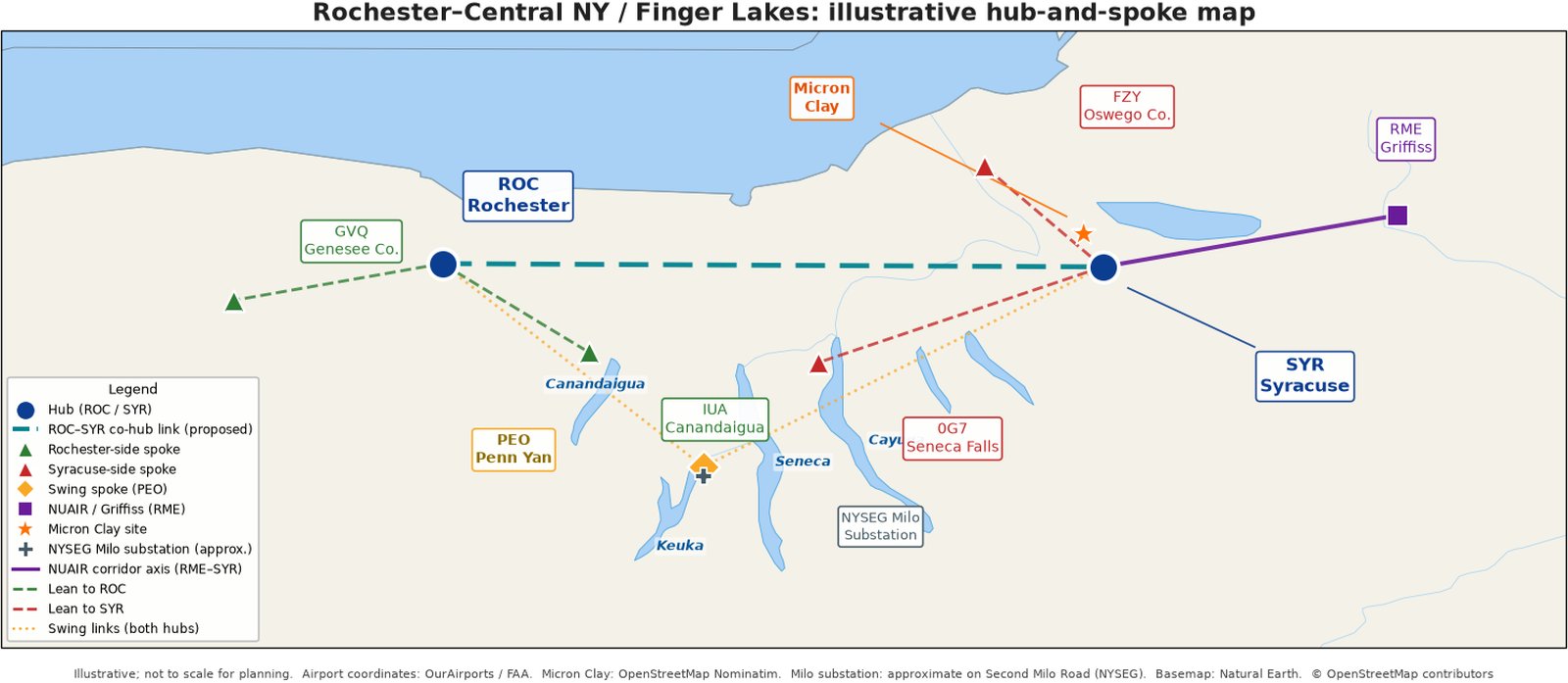
Syracuse Hancock International (SYR) and Frederick Douglass Greater Rochester International (ROC) are both FAA small-hub primary airports in the National Plan of Integrated Airport Systems (NPIAS) 2025–2029. SYR recorded 1,412,838 enplanements in CY2023; ROC recorded 1,325,336 (FAA NPIAS 2025–2029 Appendix A).
SYR is where nearly all of the region's public advanced air mobility (AAM) activity sits. The City of Syracuse owns the airport; it is operated by the Syracuse Regional Airport Authority (SRAA). SRAA's FAA-approved master plan includes three vertiport locations and a future STOL runway (NUAIR / SRAA release, Mar 12, 2026). NUAIR's corridor has grown from a 50-mile Rome-to-Syracuse BVLOS link to about 1,900 square miles of FAA-accepted airspace, with more than 6,000 BVLOS flights flown. Central New York is described as a critical operational hub in the Port Authority of New York and New Jersey–led FAA eVTOL Integration Pilot Program (eIPP); no eIPP flight at SYR had been reported as of this writing. Micron's Clay megafab — a roughly $100 billion four-fab vision, with about 9,000 direct jobs and up to nearly 50,000 statewide including the supply chain (NIST CHIPS — Micron New York; ESD, Apr 25, 2024; Micron, July 9, 2026) — is the industrial anchor in the catchment. Treat Micron as a multi-decade construction-then-operations demand driver, not as current SYR boardings. None of those primary sources publish a Micron-attributable passenger forecast.
ROC is the co-hub with an empty chair. Monroe County owns it; the Monroe County Airport Authority operates it. ROC's current master plan and 2025 annual report contain no eVTOL, vertiport, AAM, or UAS item (ROC master plan; ROC 2025 Annual Report). ROC is not among the named eIPP sites. The only public signal in the region is that New York State Sen. Jeremy Cooney, chair of the Senate Transportation Committee, has said the state should invest in Rochester and other regional airports — including charging — for vertical-takeoff service (paraphrase of remarks on WXXI Connections, Feb 27, 2025; PBS / WXXI). That gap is the opportunity a ready sponsor can fill.
What each spoke brings
The spoke fields below are verified in NPIAS 2025–2029 Appendix A. Ownership and runway data come from FAA 5010 records via AirNav.
Rochester side. Canandaigua (IUA) is a NPIAS Regional reliever with 69 based aircraft. It is owned by the Ontario County Industrial Development Agency — an economic-development agency that uses the airport expressly to recruit business, including a $1.485 million state grant for a new GA terminal in 2018 (fingerlakes1.com, 2020). IUA sits about 20 nm from ROC and about 55 nm from SYR, so it leans clearly toward Rochester. Genesee County (GVQ) is a NPIAS Regional reliever between the Buffalo and Rochester corridors; no public AAM activity was found there.
Syracuse side. Oswego County Airport (FZY) in Fulton is a NPIAS GA Regional field with 89 based aircraft, owned by Oswego County. The county markets an adjacent 170-acre Airport Industrial Park as within about 20 miles of Micron's Clay site, with National Grid holding a facility in the park (Oswego County Airport Industrial Park). Finger Lakes Regional / Seneca Falls (0G7) is a NPIAS Local field owned by Seneca County, sitting between Cayuga and Seneca lakes near Women's Rights National Historical Park and del Lago Resort & Casino — the destination spoke (fingerlakesairport.com).
The swing spoke. Penn Yan / Yates County (PEO) is a NPIAS Regional field with 55 based aircraft, owned by Yates County. Keuka Lake wineries sit a few miles away (pennyanairport.org). Straight-line distance puts PEO closer to ROC than to SYR, but only modestly so; it can serve either hub. Separately, NYSEG completed a full rebuild of the Milo substation on August 25, 2026, and named Penn Yan Airport as a beneficiary (NYSEG). That is a citable utility-partner fact, not a claim that NYSEG would fund an AAM pad.
Tourism as a pool, not a forecast. Finger Lakes visitor spending reached $4.587 billion in 2024, supporting 55,418 jobs (ESD / Tourism Economics 2024 Finger Lakes regional report). Monroe County alone accounted for about $1.46 billion; Onondaga about $1.29 billion; Ontario about $378 million. Watkins Glen and Letchworth State Parks each drew roughly 1.3–1.4 million visits in 2025 (NYS Open Data — State Park Annual Attendance). Those figures show large leisure pools near the spokes. They do not show how many visitors arrive by air, or how many would pay for a short-hop air taxi.
None of IUA, FZY, 0G7, or GVQ shows public AAM activity. That empty slate is exactly why a sponsor that arrives with its own case has leverage.
A regional coalition — with ROC and SYR at the core
I looked for a public ROC–SYR collaboration on AAM, joint air-service planning, a shared regional study, an MOU, or joint marketing. I did not find one. What I found instead are two hubs working in parallel. SYR, through SRAA, has the AAM master-plan slots, the NUAIR partnership, and a Central New York role in the FAA eIPP (NUAIR / SRAA); SRAA also joined a 2022 MOU for a Syracuse–Québec international AAM corridor that does not include Rochester (SRAA / VPorts). ROC, through Monroe County and the Monroe County Airport Authority, has focused on air-service growth and reducing passenger leakage to other airports; its master plan and 2025 annual report do not list AAM items (ROC master plan; ROC 2025 Annual Report). Both airports won separate awards under NYSDOT's Upstate Airport Economic Development and Revitalization Competition — parallel applicants, not a joint project (Governor's 2022 awards). ESD's statewide Next Generation Aviation Strategic Plan has not been published as of this writing; it is not a bilateral ROC–SYR agreement (ESD board materials, Nov 20, 2025).
A regional AAM system almost demands that the two hubs coordinate. Both would benefit. ROC would benefit most. SYR already holds the activity and the program roles. ROC holds the empty chair and the western spokes (IUA, GVQ, and a claim on the swing at PEO). A network needs both ends. Nothing in the public record says either airport has agreed to that.
Air-service leakage is part of why. Travelers in each hub's catchment already drive to the other — or to Buffalo (BUF) — for fares or nonstops. That cross-catchment flow is shared demand evidence and a practical reason to collaborate; a regional AAM link could keep some of those short hops inside the regional system instead of on the Thruway. ROC's airport director has publicly described leakage from the Rochester market to Buffalo, Syracuse, Toronto, New York City, and other airports, with the airport capturing roughly four-fifths of "its" travelers and losing the rest (WHEC, quoting Airport Director Andy Moore). I found no published joint ROC–SYR true-market or leakage study. A shared leakage / true-market analysis is a no-capital first step either hub can propose without waiting for capital or an MOU.
"Coalition" is an overused word. Here it fits. The two hubs are the core. Around them sit organizations that already have real roles in this geography — none of which, on the public record I reviewed, has joined or agreed to a regional AAM coalition. One-line roles each can realistically play now:
| Member | A realistic role now |
|---|---|
| ROC / Monroe County Airport Authority | Put AAM on the planning agenda and bring western-spoke demand evidence to a shared table |
| SYR / SRAA | Share master-plan, NUAIR, and eIPP lessons so the western side does not reinvent them |
| NUAIR | Extend corridor and airspace know-how beyond the Rome–Syracuse axis as the network design matures |
| NYSDOT (aviation) | Keep AIR NY and Upstate capital programs open to AAM-ready, ALP-consistent projects when solicitations reopen |
| NYSDOT (highway / multimodal) | Treat ground access to hubs and spokes as part of the same trip, not a separate silo |
| ESD | Use the Next Generation Aviation Strategic Plan to map both hubs and their spokes into one statewide picture |
| Greater Rochester Enterprise | Fold AAM readiness into ROC's air-service and economic-development story |
| CenterState CEO | Connect Central NY's UAS / AAM ecosystem (including GENIUS NY) to a two-hub network, not a one-hub story |
| County IDAs (e.g., Ontario County IDA at IUA) | Keep using airport land and terminals as business-recruitment tools under clear aeronautical rules |
| Hospitality / tourism / gaming (Finger Lakes tourism bodies; del Lago and peer destinations) | Supply visitor O&D and itinerary data that turn tourism pools into usable demand evidence |
No-capital first steps a hub pair could take without waiting for a capital program:
- A joint letter to ESD's Next Generation Aviation Strategic Plan asking that both hubs and their spokes be mapped together.
- A shared demand-data request — O&D, ground access, itinerant ops, and charter samples — so neither side negotiates blind.
- A joint leakage / true-market study covering ROC, SYR, and BUF catchments.
- Coordinated minimum standards for AAM activity, so operators face one clear rule set across the region instead of two conflicting ones.
Those steps do not commit either airport to a deal. They put the region on the record as a network.
Location is not demand
Proximity to Micron, a winery trail, or a state park does not prove AAM demand — or even general-aviation demand. Being listed in the NPIAS means federal planning recognition and a path to Airport Improvement Program (AIP) eligibility for eligible airport development. It does not mean a certified vertiport design, charging power, fire/rescue capability for eVTOL, or a rate base that can carry maintenance and operations. Employer headcounts (University of Rochester, Wegmans, L3Harris, Cornell, SUNY Upstate, Syracuse University, Lockheed Martin, and others) create business and visiting-family travel; the share that would choose a premium short hop over car or rideshare is unmeasured here. Utility EV make-ready programs are for highway and depot vehicles; they are not aviation charging products.
What would turn location into demand:
- Passenger and visitor origin–destination and ground-access surveys at ROC, SYR, and nearby commercial fields
- Itinerant versus local operations and fuel-sales trends at the candidate spokes (FAA 5010 / airport records)
- Charter, Part 135, and air-ambulance samples by destination field
- Employer travel patterns and temporary-worker lodging patterns, once shareable
- Stated-preference work on named city pairs
- Utility capacity maps and interconnection cost estimates at named pad sites — not generic make-ready marketing
Sponsors that gather this evidence negotiate. Sponsors that skip it react.
The money, honestly
Lead with what is verified. Leave open what is open.
AIP. For small-hub, nonhub, and nonprimary airports, the standard federal share is 90 percent (49 U.S.C. 47109). The temporary 95 percent share for FY2025–FY2026 at nonhub and nonprimary airports does not apply to new FY2027 grants (49 U.S.C. 47109(h); FAA R-PGL 25-05). Electric-aircraft charging assessments and related power development to meet current and future demand are AIP-eligible under 49 U.S.C. 47140 as amended and FAA R-PGL 25-06 (May 12, 2025). Put charging and power — and any pad element the Airports District Office will accept — into the Airport Capital Improvement Plan now. Lead with entitlement plus the 90 percent share; treat discretionary as a second step. Vertiport pad eligibility as a general AIP category remains an open question; do not promise it.
BIL Airport Infrastructure Grants (AIG). Final FY2026 allocations are posted (FAA AIG amounts). FY2023 funds had to be obligated by September 30, 2026, and that deadline has now passed; FY2026 funds have until September 30, 2029. Charging stations may use AIG when treated as fuel-farm / low-emission fuel systems with a revenue justification comparable to traditional fuel — eligibility runs through the 47140 / R-PGL 25-06 path; confirm scope with the ADO.
What does not cover aircraft charging. NYSERDA's Charge Ready NY 2.0 funds Level 2 chargers at workplaces, multifamily housing, and hotels — not aircraft (NYSERDA Charge Ready NY). The New York Public Service Commission Make-Ready Program (Case 18-E-0138) covers light-duty Level 2 and DC fast charging; whether electric-aircraft charging qualifies under the light-duty program or the medium- and heavy-duty "non-road" pilot is not verified (Joint Utilities MHD Pilot). Empire State Development's Green CHIPS Community Investment Fund awards workforce, education, community, and housing projects only — not airport or AAM capital (ESD Green CHIPS CIF). Do not treat Micron, National Grid, NYSEG, or RG&E as a committed funder of any airport AAM project. They appear here as geography and partner examples only.
State aviation capital. NYSDOT's AIR NY (Airport Investment and Revitalization for New York) last solicited applications due January 22, 2025, and awarded $25 million to 16 airports, with a $2.5 million cap per project and up to a 90 percent state share for general-aviation fields (NYSDOT aviation grants; 2024 NOFA). No open 2026 solicitation appears on the NYSDOT page as of this writing. When the next round opens, sponsors that already have demand evidence and an ALP-ready scope will be ahead.
Get on the state record now. On November 20, 2025, the ESD board authorized a contract with Steer (not to exceed $482,589, seven-month term) for a Next Generation Aviation Strategic Plan covering AAM and UAS, including infrastructure integration at New York airports and vertiports (ESD board materials, Nov 20, 2025, pp. 321–323). No plan has been published yet. Sponsors that want their fields counted should get on record before it is published.
The AAM National Strategy (Dec. 17, 2025) Recommendation 2.2 calls on federal agencies to work with state and local governments on future financing models while funding existing programs for early operations. Recommendation 7.3 reads: "Congress should examine existing aviation funding methods and, if necessary, update them" (DOT AAM Strategy). In a3i's view, that review should ask whether those methods leave thin-revenue hosts carrying private capital risk and perpetual maintenance alone. Using AIP, remaining AIG, and AIR NY when open is Rec 2.2 in practice.
What a sponsor can and cannot promise
Regulatory analysis, not legal advice. Assurances attach from grants and deeds, not from NPIAS listing alone. Order 5190.6C (effective Feb. 20, 2026) still contains no mention of vertiport, eVTOL, powered-lift, or advanced air mobility; the FAA AAM Infrastructure page FAQ is the only AAM-specific compliance statement found for this piece (FAA AAM Infrastructure; Order 5190.6C).
No exclusive rights. 49 U.S.C. 40103(e), 47107(a)(4), and Assurance 23 bar a private exclusive right to provide aeronautical services to the public. A single provider is not automatically a violation absent an express agreement or an apparent intent to exclude (Order 5190.6C §8.5, §8.8.b). A sponsor cannot, as a matter of convenience, choose to have only one. Options and rights of first refusal on space "must generally be avoided" (§8.6.b). The proprietary exclusive lets the sponsor provide fuel or support services itself with its own employees and resources — "not for use of the landing area itself" (§8.8.a). FAA's AAM FAQ: sponsor-furnished chargers must be available to all aeronautical users (non-exclusive); an operator's exclusive-use leased space with its own chargers is not an exclusive right.
Reasonable, nondiscriminatory terms. Assurance 22 and 47107(a)(1)–(6) require the airport to be available for public use on reasonable conditions without unjust discrimination, covering "all types, kinds and classes of aeronautical activities." Minimum standards follow AC 150/5190-8 (Dec. 7, 2023); write standards that fit the AAM activity, not FBO standards copied over.
Fees and self-sustaining. Assurance 24 and 47107(a)(13) require charges that make the airport as self-sustaining as possible. Aeronautical users pay reasonable, cost-based rates; nonaeronautical uses pay fair market value (Order 5190.6C §17.9–17.11; Rates and Charges Policy, 61 FR 31993, as republished at 78 FR 55330).
Revenue stays on the airport. 47107(b)(1)(A)–(C) and 47133(a)(1)–(3), Assurance 25, and the Revenue Use Policy (64 FR 7696) require airport revenues to go to (A) the airport, (B) the local airport system, or (C) other local facilities owned or operated by the airport owner or operator and directly and substantially related to the air transportation of passengers or property. Funding a pad the sponsor neither owns nor operates likely fails prong (C). Whether a remote pad is part of the parent airport remains an open question — the same open question in Who Owns the Remote Pad?
Leases and notice. FAA does not approve leases (Order 5190.6C §12.3–12.4). Ground leases of 30 to 35 years are typical; terms over 50 years may be treated as a disposal. Keep leases subordinate to the sponsor's federal obligations. Keep the airport layout plan current (47107(a)(16), Assurance 29). A new landing area needs Part 157 notice on Form 7480-1 at least 90 days ahead; FAA's determination is advisory (14 CFR Part 157).
Practical reading for a first-operator deal. The sponsor can offer a first operator a leasehold it uses exclusively — stands, a hangar, its own chargers. It cannot offer launch exclusivity, a right of first refusal on future pad sites, or a pad the operator controls as the airport's only vertical-flight landing area. Keep the takeoff and landing area under sponsor control and open to common use.
A sponsor's playbook — no capital required
None of these steps requires a groundbreaking photo:
- Gather demand evidence. Origin–destination and ground-access surveys; itinerant ops and fuel sales at the spokes; charter samples; employer travel patterns; stated-preference work on named pairs.
- Start the utility conversation. Capacity and interconnection at named pad sites. Do not assume make-ready eligibility for aircraft chargers until the utility and the PSC rules say so.
- Write minimum standards that fit AAM activity and stay nondiscriminatory under Assurance 22.
- Invite proposals on the airport's terms — scope, performance, step-in, and M&O reserve into an airport-controlled account — rather than reacting to an operator's form lease.
- Build the regional coalition. ROC and SYR are the core; NUAIR, NYSDOT, ESD, economic-development partners, and hospitality/tourism belong in the room. Spokes that arrive with shared demand evidence negotiate from a stronger position than any single field alone.
- Get on the state record. ESD's aviation strategic plan has not been published yet. AIR NY will open again. Sponsors that wait for the NOFA to start writing their case will be late.
Private capital can fund the build and specialized operations. It is not the maintenance plan. Grant assurances and revenue-use duties stay with the public party that accepted them.
Bottom line for airport sponsors
- Stop waiting for the operator letter. Bring your own business case first.
- Rochester and Central New York show the pattern — and I chose them because this is my backyard: one hub with concentrated AAM activity, one co-hub with an empty chair, and spokes that already sit in the NPIAS with tourism, industrial, and economic-development identities — and almost no public AAM of their own. A regional system almost demands a ROC–SYR coalition.
- Location is not demand. Gather the surveys, ops data, and utility capacity numbers that turn geography into a negotiating position.
- Fund what is eligible (AIP charging/power at 90 percent in FY2027; remaining AIG before obligation deadlines; AIR NY when open). Do not invent eligibility in programs that do not cover aircraft charging.
- Promise only what Assurances 22–25 and the revenue-use statutes allow. No private exclusive rights. Sponsor chargers stay open. Fees stay reasonable. Revenue stays on the airport. Own or operate any remote pad that airport money will touch.
- The no-capital playbook — evidence, utility talks, minimum standards, sponsor-led solicitations, a ROC–SYR-centered coalition, and a seat at the state table — is available now.
a3i works with airport sponsors, municipalities, and economic development organizations on readiness and partnership assessments: demand evidence, funding stacks, assurance-safe deal structures, and regional coalition design. If that is useful where you sit, reach out.
For how a public-use pad gets into the national plan, see Destinations, Not Hangars. For who can spend airport money on a remote pad, see Who Owns the Remote Pad?.
Richard S. Walsh is Founder of a3i global aeronautics advisors, LLC, and a former NASA contractor with more than 30 years in aviation. A Rochester native who lives in Monroe County, he previously served as Airport Director (CEO) of Palm Springs International Airport (PSP) and held leadership positions with SFO, ACAA, and NYSDOT.
This article is regulatory and policy analysis for discussion. It is not legal advice, not a grant application, and not an FAA filing. Written with AI tools; the views are my own.
Companion Insights pieces: Destinations, Not Hangars — parallel NPIAS path for public-use vertiports. Who Owns the Remote Pad? — on-airport vs airport-sponsored remote vs city-built ownership.
Sources
- FAA NPIAS 2025–2029 Appendix A — https://www.faa.gov/sites/faa.gov/files/airports/planning_capacity/npias/current/ARP-NPIAS-2025-2029-AppendixA.xlsx
- NUAIR / SRAA eIPP release (Mar 12, 2026) — https://www.nuair.org/post/nuair-and-syracuse-regional-airport-authority-celebrate-federal-selection-of-port-authority-of-new-y
- NIST CHIPS — Micron New York (Clay) — https://www.nist.gov/chips/micron-new-york-clay
- ESD — Micron / CHIPS (Apr 25, 2024) — https://esd.ny.gov/esd-media-center/press-releases/governor-hochul-celebrates-biden-administrations-61-billion-investment-in-micron
- Micron — first concrete / U.S. investment (July 9, 2026) — https://investors.micron.com/news/press-release/2026/Micron-Accelerates-U-S--Investments-Pours-First-Concrete-at-New-York-Fab/default.aspx
- ROC master plan — https://www.rocairport.com/files/mcaa/roc-master-plan.pdf
- ROC 2025 Annual Report — https://www.rocairport.com/files/mcaa/2025/annual/ROC%20Airport_2025%20Annual%20Report%20Final_Online.pdf
- WXXI / PBS — Sen. Jeremy Cooney on Rochester airport (Feb 27, 2025) — https://www.pbs.org/video/senator-jeremy-cooney-on-whats-next-for-rochesters-airport-and-air-travel-in-the-region-ufxqdj/
- Oswego County Airport Industrial Park — https://www.oswegocounty.org/airport_industrial_park.php
- Canandaigua Airport / OCIDA economic-development coverage — https://www.fingerlakes1.com/2020/02/19/canandaigua-airport-project-could-pay-dividends-in-economic-development-effort-locally/
- Finger Lakes Regional Airport — https://fingerlakesairport.com/
- Penn Yan Airport — https://www.pennyanairport.org/
- NYSEG Milo substation rebuild (Aug 25, 2026) — https://www.nyseg.com/w/nyseg-completes-full-rebuild-of-milo-substation-to-strengthen-grid-in-yates-county
- ESD / Tourism Economics — Finger Lakes 2024 visitor spending — https://assets.simpleviewinc.com/simpleview/image/upload/v1/clients/fingerlakesvc/2024_NYS_Tourism_Economic_Impact_Finger_Lakes_fbda1e3d-c6a5-4db2-af6c-03c79d2eb724.pdf
- NYS Open Data — State Park Annual Attendance by Facility — https://data.ny.gov/Recreation/State-Park-Annual-Attendance-Figures-by-Facility-B/8f3n-xj78
- 49 U.S.C. 47109, 47140, 47107, 47133, 40103 — https://www.law.cornell.edu/uscode/text/49
- FAA R-PGL 25-05 — http://faa.gov/airports/aip/guidance_letters/R-PGL-25-05-Funding-Formula-Changes
- FAA R-PGL 25-06 — https://www.faa.gov/airports/aip/guidance_letters/R-PGL-25-06-Planning-Project-Eligibility
- FAA AIG funding amounts — https://www.faa.gov/iija/iija-airport-infrastructure-grant-funding-amounts
- NYSDOT aviation grants / AIR NY — https://www.dot.ny.gov/aviationgrants
- NYSDOT AIR NY 2024 NOFA — https://www.dot.ny.gov/divisions/operating/opdm/aviation/repository/2024%20NOFA-Guidelines%20Final.pdf
- NYSERDA Charge Ready NY 2.0 — https://www.nyserda.ny.gov/All-Programs/Charge-Ready-NY
- Joint Utilities MHD Make-Ready Pilot — https://jointutilitiesofny.org/ev/make-ready/MHD-pilot-program
- ESD Green CHIPS Community Investment Fund — https://esd.ny.gov/green-chips-community-investment-fund
- ESD board materials — Next Generation Aviation Strategic Plan (Nov 20, 2025) — https://esd.ny.gov/sites/default/files/media/document/112025ESDBoardMeetingMaterials.pdf
- DOT AAM National Strategy — https://www.transportation.gov/aam-strategy
- FAA AAM Infrastructure page — https://www.faa.gov/airports/new_entrants/aam_infrastructure
- FAA Order 5190.6C — https://www.faa.gov/airports/resources/publications/orders/compliance_5190_6/order-5190-6c-compliance-complete
- FAA Airport Sponsor Assurances — https://www.faa.gov/airports/aip/grant_assurances
- 14 CFR Part 157 — https://www.law.cornell.edu/cfr/text/14/157
- Revenue Use Policy, 64 FR 7696; Rates and Charges Policy, 61 FR 31993 / 78 FR 55330
- a3i Insights — Destinations, Not Hangars — https://a3iglobal.com/insights/destinations-not-hangars/
- a3i Insights — Who Owns the Remote Pad? — https://a3iglobal.com/insights/who-owns-the-remote-pad/
- SRAA / VPorts — Syracuse–Québec AAM corridor MOU (Nov 29, 2022) — https://syrairport.org/2022/11/29/vports-to-create-the-first-international-advanced-air-mobility-corridor-between-syracuse-ny-and-quebec/
- Governor Hochul — Upstate Airport Economic Development awards (2022) — https://www.governor.ny.gov/news/governor-hochul-announces-230-million-lift-nine-upstate-airports-new-heights
- OurAirports airports.csv (FAA-sourced airport coordinates) — https://davidmegginson.github.io/ourairports-data/airports.csv
- Natural Earth (basemap) — https://www.naturalearthdata.com/
- OpenStreetMap Nominatim — Micron Clay / Second Milo Road geocoding — https://nominatim.openstreetmap.org/
- WHEC — ROC airport director on passenger leakage (Buffalo, Syracuse, and others) — https://www.whec.com/top-news/rochester-airport-aims-to-reduce-leakage-of-local-travelers-to-other-airports-to-attract-more-airlines-and-lower-fares/